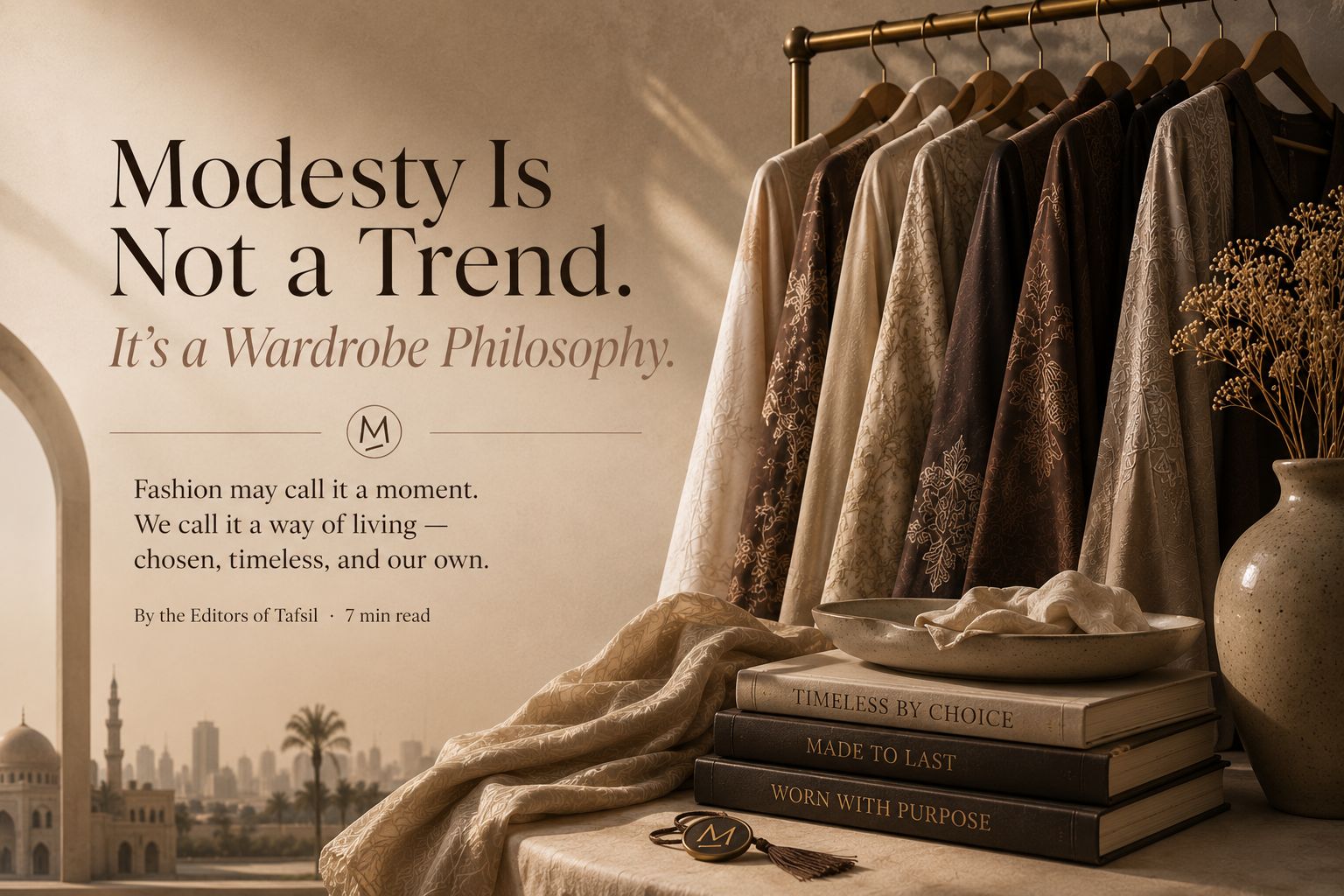



The fashion industry has discovered modest dressing. But what gets called "modest" on a runway is rarely the same thing as what gets lived in.
By the Editors of Tafsil · 7 min read
Something is happening in fashion right now. Dior has put out a modest capsule. Valentino has reframed coverage as elegance. Prada is suddenly drawn to the long sleeve. TikTok has named it "demure," then "old money," then "quiet luxury," then something else by the time you read this. The runways and the algorithms have, in their own ways, noticed what some women have been wearing all along.
This is not nothing. It is, in some ways, a quiet vindication. For decades, modest dressing was treated as either a religious obligation or a fashion exile. To see it recognized as an aesthetic choice on its own terms, separate from any single faith or culture, is a meaningful shift. We are not going to pretend it isn't.
But we are also going to draw a line.
The Modest Fashion Moment
The fashion industry has discovered the word "modest." It has put it on a moodboard. It has shown it on a runway. It has packaged it as a capsule. And the capsule will, like all capsules, end. The next season will have a different name. The brand will move on. The garments will go on sale, then to outlet, then to the back of a closet, then to landfill, and the conversation will turn to the next thing women are supposed to wear if they want to look current.
This is what trends do. This is their entire function. They make a thing fashionable, then they make it unfashionable, then they sell you something else.
Why a Trend Cannot Hold a Wardrobe
A trend is, by definition, temporary. That is not a criticism, it is a description. The trend cycle is how the industry stays in business: by ensuring that what you wore last season is no longer enough for this one. There is nothing wrong with following one if you enjoy them. But you cannot build a wardrobe out of trends. You can only build a rotation.
A wardrobe philosophy is the opposite. It is a slow accumulation of pieces that have been chosen, not adopted. Kept, not cycled. Worn, mended, sometimes passed on. It does not care what is on the runway in October. It cares what is in the closet in ten years.
When modest dressing is treated as a trend, it is asked to do the work of a trend: be timely, be replaceable, be over by spring. When it is treated as a wardrobe philosophy, it is asked to do something much harder: be lasting.
A trend tells you what to buy this season. A wardrobe philosophy tells you what to keep for a generation.
What a Wardrobe Philosophy Actually Looks Like
A wardrobe philosophy has visible markers. The pieces are chosen for fabric, not for season. The cuts are forgiving across the years a body changes. The colors are ones the wearer has been drawn to for decades, not the ones a forecasting agency named in February. The closet is smaller than it sounds. There is room for everything because everything earns its place. Pieces are repaired before they are replaced. Sometimes they are inherited. Sometimes they are passed on.
For modest dressers, this is not a discovery. It is a description of how a great many women in the Gulf, in the Levant, in North Africa, in Pakistan, in Indonesia, have always kept their wardrobes. Pieces of careful tailoring, made to last. Embroidery that took weeks. Fabric chosen for the climate. Cuts that move with a body across phases of life. The covered wardrobe, when it is done well, has always been the slowest wardrobe in fashion. It was building this way long before the industry had a word for it.
The Risk When Modest Becomes a Trend
Here is what we are watching carefully. When the wider fashion industry discovers a wardrobe philosophy, it tends to take only what can be sold this quarter, and leave the rest. Modest capsules will arrive in stores cut from fabrics that pill in a month. Long sleeves will be tacked onto otherwise unchanged collections and labeled "modest." Some brands will do this seriously. Many will not.
The women who have lived this wardrobe philosophy for generations are not the ones in danger of being confused. The ones in danger are the women just discovering it now, who may be sold something with a label and a hashtag, and may not yet know how to tell a philosophy from a season.
How Mizyana Selects for Longevity, Not Season
This is the lens through which we curate. We are not interested in a brand because the algorithm is. We are interested in whether a piece was built to last five years, ten years, longer. Whether the fabric will hold up in the wash. Whether the cut respects how a body actually moves, prays, sits, walks. Whether the brand makes the same garment ethically every season, or whether it pivots according to whatever a forecaster said was coming.
A trend cannot tell you any of this. A wardrobe philosophy already has.
Modesty was here before the runway noticed. It will be here after. What is happening now is that more women are paying attention to a wardrobe tradition that has always been doing the harder, slower, more interesting work. We welcome the attention. We just want to make sure no one confuses the season for the substance.