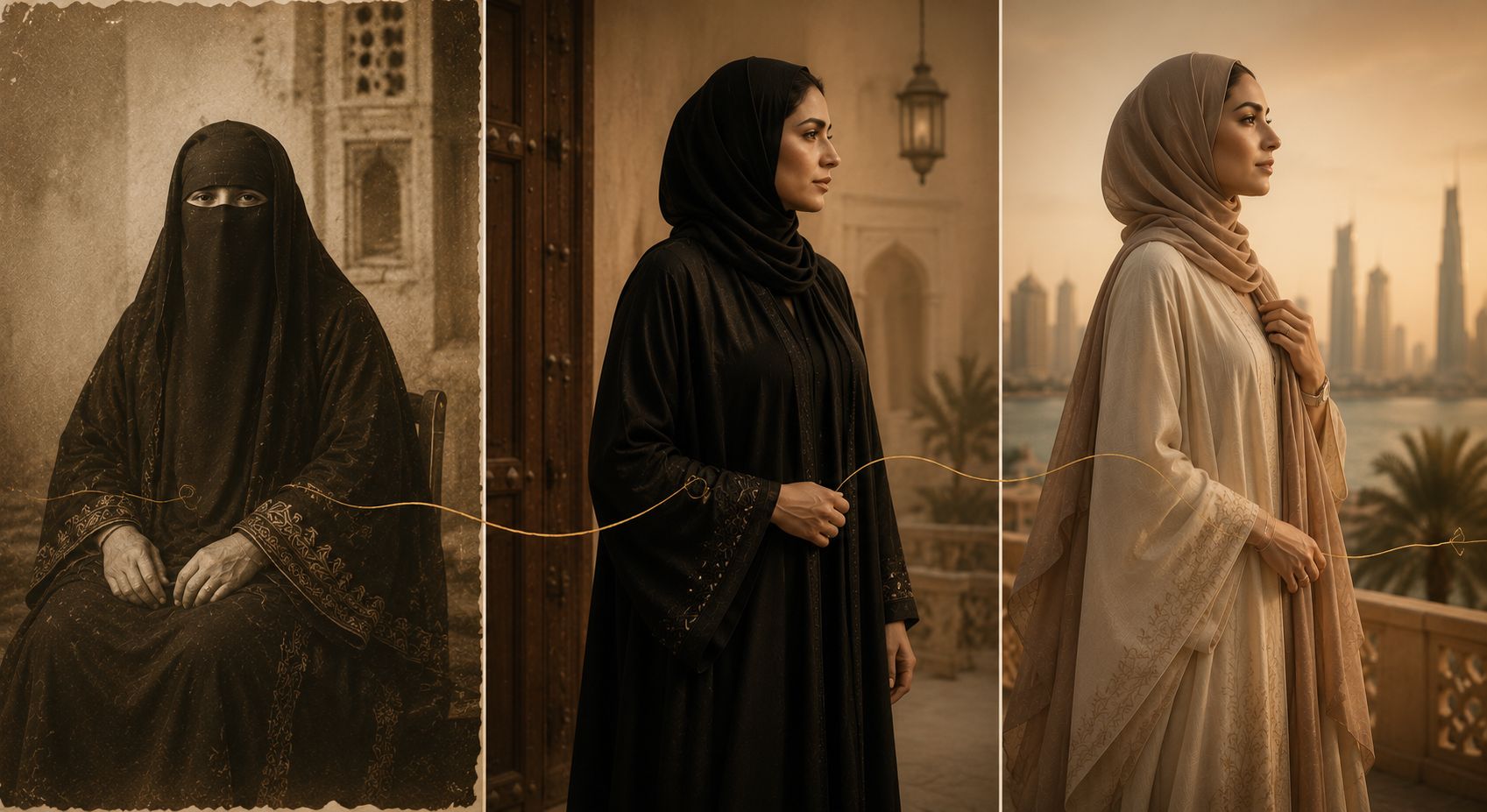



A meditation on three generations of modesty in the Gulf, and what stays the same when everything else changes.
By the Editors of Tafsil · 8 min read
There is a photograph in many Gulf households. The grandmother in a niqab. The mother in a black abaya. The daughter in something less easy to name. Three generations in one frame, three different relationships to modesty, three different vocabularies for the same intention.
If you grew up here, you have seen this photograph in your own family. The way modesty has expressed itself across three generations of Gulf women is one of the quietest, most consequential cultural shifts of the last hundred years. It is worth paying attention to.
This is a brief history of one wardrobe across three women.
The Grandmother's Niqab
She did not pick it. She inherited it. The way her mother wore it, the way her aunts wore it, the way every woman in her neighborhood wore it. The niqab was not a fashion choice and would not have been described as one. It was the silhouette of belonging.
This does not mean it was joyless. Look at the photographs and the fabric is often beautiful: black silk, sometimes embroidered at the edges, fitted with the precision of a tailor who knew her family for forty years. The hijab beneath was layered with care. The hem of her thobe might carry a kind of gold work that would now sell at auction. She was not absent from style. She was operating in a style system her granddaughter has trouble reading, because the system has changed faster than the literacy.
She was modest because her mother was modest. She did not ask the question. The question had not yet been asked.
The Mother's Abaya
When the mother became old enough to wear an abaya of her own, things had begun to move. The abaya was still black. It was still long. But the cut had loosened. She might have a few of them. One for everyday, one for the family majlis, one for travel. A new word entered the language: design. A new category appeared in the wardrobe: occasion.
She wore her mother's niqab on the day of her wedding, then folded it and kept it. She did not wear it after. Her own face was uncovered, her hair fully under the hijab, her abaya black and long but cut to reveal the work of the seam. She had a tailor. She had opinions about embroidery.
The question had begun to be asked. Not "should I be modest?" but "what does my modesty look like?" The first is theological. The second is aesthetic. The shift between them was generational.
The Daughter's Wardrobe
The daughter has options her grandmother would not have recognized. Abayas in cream and sand and bronze. Hijabs in fabric weights chosen for season. Silhouettes that move differently in the wind. A wardrobe rotated against weather, mood, occasion, and the social register of any given Tuesday. Some days she wears her grandmother's old abaya for Eid, paired with a hijab in a color her grandmother would never have considered. Some days she wears a piece she ordered online from a designer in Riyadh she has never met, who has somehow understood her exactly.
She is no less modest than her grandmother. She is differently modest, and the difference is that she is the one choosing.
The question has fully landed. "What does my modesty look like today, with my body as it is now, in the room I will be in this afternoon?" The question is not religious. It is not aesthetic. It is both, in the same breath, and she takes it for granted that both can be in her own hand.
The garment changed across three generations. The intention did not. What changed is the vocabulary that the intention could use.
What Did Not Change Across Three Generations
The thread you can trace from the grandmother to the daughter is not the cut or the color or the silhouette. The thread is the intention. Each of these women, in her own decade, made a series of choices about how she would be seen. The grandmother's choices were narrow. The daughter's are wide. But the choices were always there. We have made a mistake when we have told ourselves that modesty in the previous generation was imposed, and modesty in this generation is chosen. Modesty has always been a relationship between a woman and her wardrobe. What changed is how many words the relationship now has to use.
The Gulf wardrobe did not become more modest or less modest across three generations. It became more articulate.
Building for the Inheritance
This is part of what Mizyana is for. The granddaughter who wants to wear her grandmother's abaya needs a hijab that respects it. The mother who wants to gift her daughter a piece for her wedding needs a marketplace that takes both their tastes seriously. The daughter who wants to build her own wardrobe wants to do it without losing the thread her family has been holding for a hundred years.
We are not interested in selling modesty as a new product. We are interested in serving the wardrobe that women in this region have been building for generations, with garments and brands worthy of that lineage. The inheritance is real. So is the choice. They were never opposites.
The next photograph will have a fourth generation. We are building for her, too.