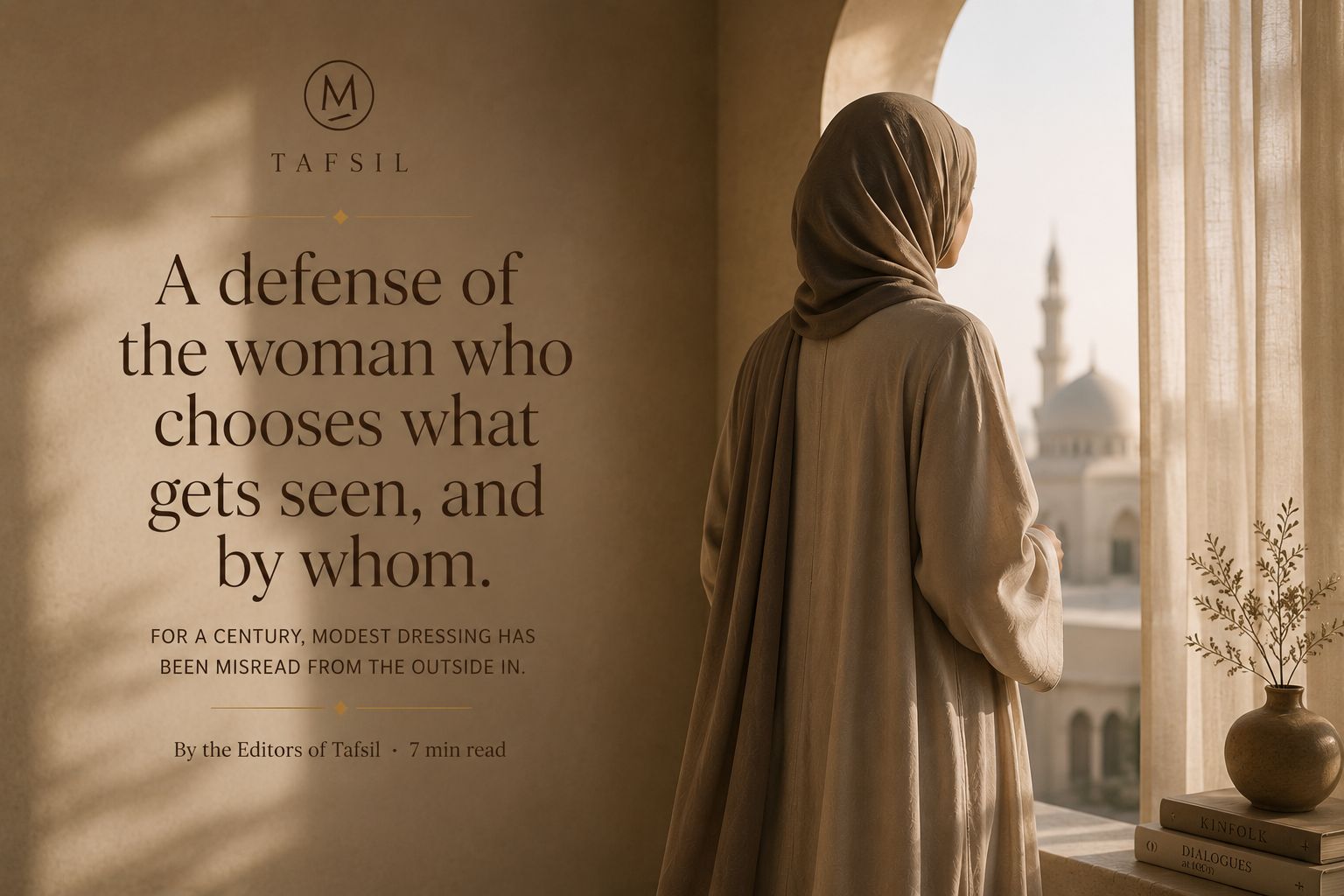



For a century, modest dressing has been misread from the outside in. A defense of the woman who chooses what gets seen, and by whom.
By the Editors of Tafsil · 7 min read
There is a question that does not get asked often enough about modest dressing, and it should. The question is: whose eyes was the wardrobe made for?
The mainstream framing of modest dressing has always been outside-in. The garment, in this framing, exists to satisfy a husband, a father, a religious authority, a cultural expectation. The covered woman is dressing for someone else's gaze. The exposed woman is, by implication, dressing for her own.
This framing is so common that it is rarely examined. But once you look at it, you notice it has the picture backwards.
The Outside-In Reading
For most of the twentieth century, the Western fashion industry and the feminist movement that grew alongside it agreed on one thing about modest dressing. It was something done to women, not by them. Coverage was assumed to be imposed. Liberation was assumed to be exposed. The covered woman was the woman whose clothing decisions had not yet caught up with her freedom.
There were good reasons for this reading, in some contexts. There are places in the world where dress codes are enforced and women have no say. We are not going to pretend otherwise. But there were also assumptions in the reading that did not survive the moment they were tested. The biggest assumption was that the woman covering up was always the one being acted upon.
The Inside-Out Reading
Talk to women who dress modestly by choice and a different picture emerges. The reason for the coverage is often the opposite of what the outside-in reading assumes. She is not dressing to be seen by someone else. She is dressing to control what gets seen, and by whom, and when. She is making a decision about her own visibility.
This is, properly understood, an act of agency. The body she carries is hers. The decision about what to show of it, and to which audience, and on which occasion, is hers. Modesty in this reading is not a withdrawal from being seen. It is an editorial position on what is worth showing, made by the only person whose judgment about her own body actually matters.
The Right to Be Unseen
There is a kind of freedom in not being available to every passing eye for evaluation. It is the freedom of a woman who walks into a room and knows that the conversation about her will not begin with her body. It is the freedom of a woman who controls the conditions under which she becomes visible. It is the freedom that the most considered modest dressers have always understood, and that the wider fashion industry, oriented toward maximum visibility, has had a hard time recognizing.
The phrase "the right to be unseen" needs care. It does not mean withdrawal from public life. It does not mean invisibility. It means choosing which dimensions of the self are made available to which audiences, on terms set by the woman herself. The covered wardrobe is one way of exercising that right. There are others. But the covered wardrobe is the one that has been most consistently misread.
What looks like withdrawal from the visible is, more often, an editorial position on what is worth showing.
Imposed Coverage and Chosen Coverage Are Not the Same Garment
This is the distinction that has to be held carefully, because it is where most outside readings break down. A niqab worn under duress is not the same thing as a niqab worn by choice, even though the cloth is identical. The cloth is not what makes them different. What makes them different is who is doing the choosing.
A wardrobe is a series of decisions. When those decisions are made by the woman wearing the wardrobe, modesty is an expression of her autonomy. When those decisions are made for her, modesty is something else. Conflating the two has done damage in both directions. It has flattened the experience of women who choose, and it has obscured the experience of women who do not have the choice.
The honest position is to name the difference, hold both realities clearly, and stop pretending that the garment alone tells the story.
What Mizyana Is Built To Recognize
The reason we run a marketplace for modest fashion is not that we think modesty is the only correct way for a woman to dress. We do not think that. We run a marketplace for modest fashion because we recognize that for a great many women, modest dressing is a considered choice that deserves to be served well. Served with garments that respect the body inside, the intention behind, and the audience selected.
We are building for the woman who has decided what she wants to show and what she wants to keep. We are building for her choice, not against anyone else's. The right to be seen, the right to be unseen, the right to set the conditions of either, all of these are hers. Our job is to make sure the wardrobe she builds is worthy of the choices she has made.
Modesty is not the rejection of being seen. It is the assertion of seeing on her own terms.