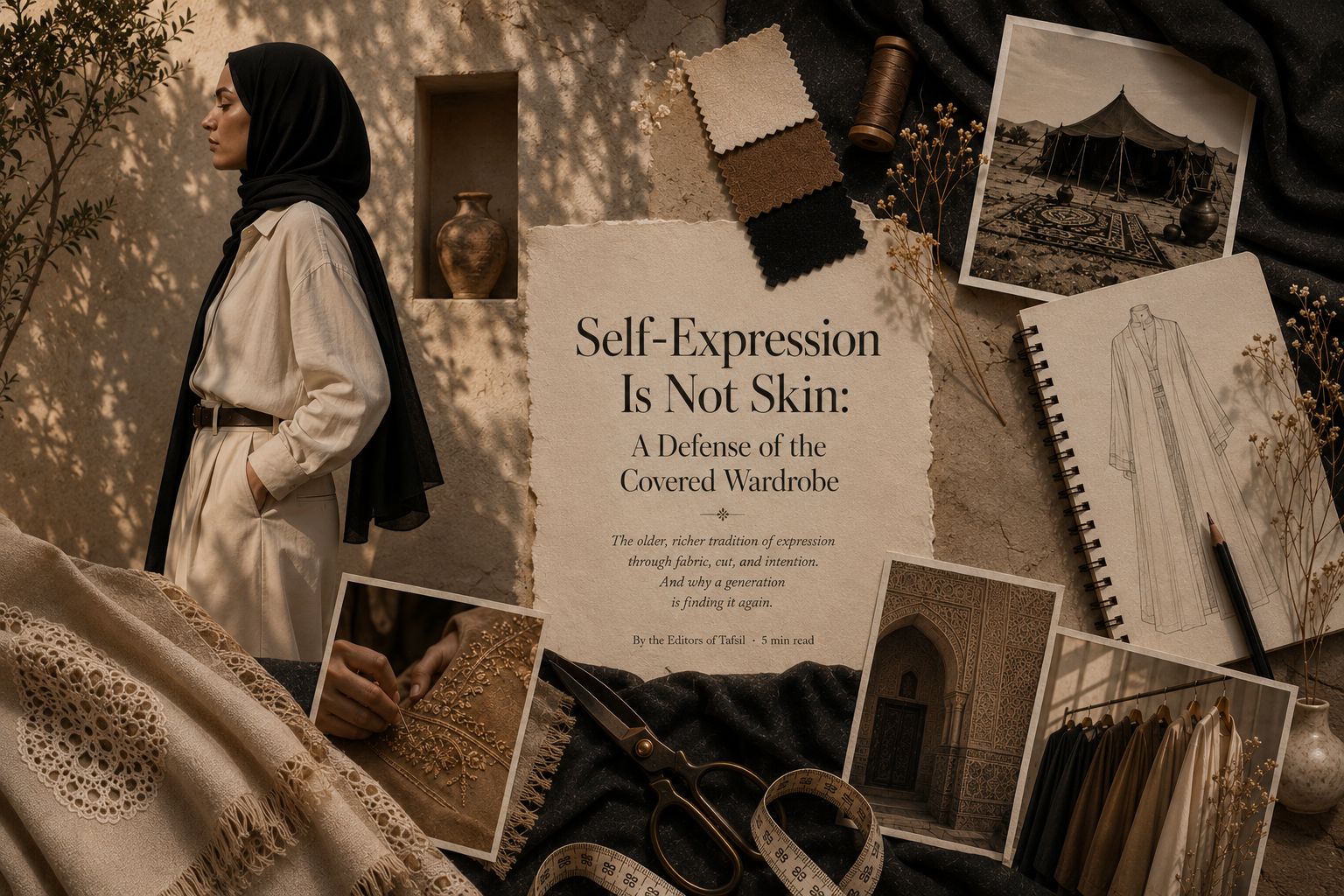



The older, richer tradition of expression through fabric, cut, and intention. And why a generation is finding it again.
By the Editors of Tafsil · 5 min read
There is a sentence that has organized the entire modern fashion industry for the better part of a century. Self-expression, the sentence says, is something you do with skin. To express yourself is to reveal yourself. To reveal less is to express less.
It is repeated so often, in fashion editorial, in advertising, and in the everyday language we use to praise women's clothing, that it has become invisible. But it is also, when you look closely, untrue.
The Older Tradition of Expression Through Fabric
The most expressive wardrobes in human history did not require exposure. The Japanese kimono, made from a single rectangular cut of cloth, communicated an entire vocabulary of season, status, mood, and intention through the way an obi was tied, the choice of pattern across the back, the colors layered at the collar. The kaftans of Damascus and Aleppo carried generations of embroidery, each region with its own dialect of gold thread. The Yemeni thobe spoke of family, tribe, occasion, even the village a woman came from, all communicated in dye and stitch and the geometry of the cut. Christian Dior's New Look, when it landed in 1947, covered the body more than fashion had in decades. It made shoulders soft, waists deep, hems long. And yet it was, by any measurable account, the most expressive moment in twentieth-century Western fashion.
None of these wardrobes asked the wearer to show skin in order to be seen.
How Fashion Narrowed Its Vocabulary
The modern fashion industry has had a particular interest in convincing women that exposure is expression. There is a commercial reason for this. An industry built on the cycle of exposure needs new things to expose. A new neckline, a new slit, a new cut-out. Each season's revelation must outdo the last. This works as a business model, but it works by collapsing a thousand-year vocabulary into a single channel.
When the only language a fashion industry speaks is skin, it stops being able to read fabric.
What the Covered Wardrobe Actually Says
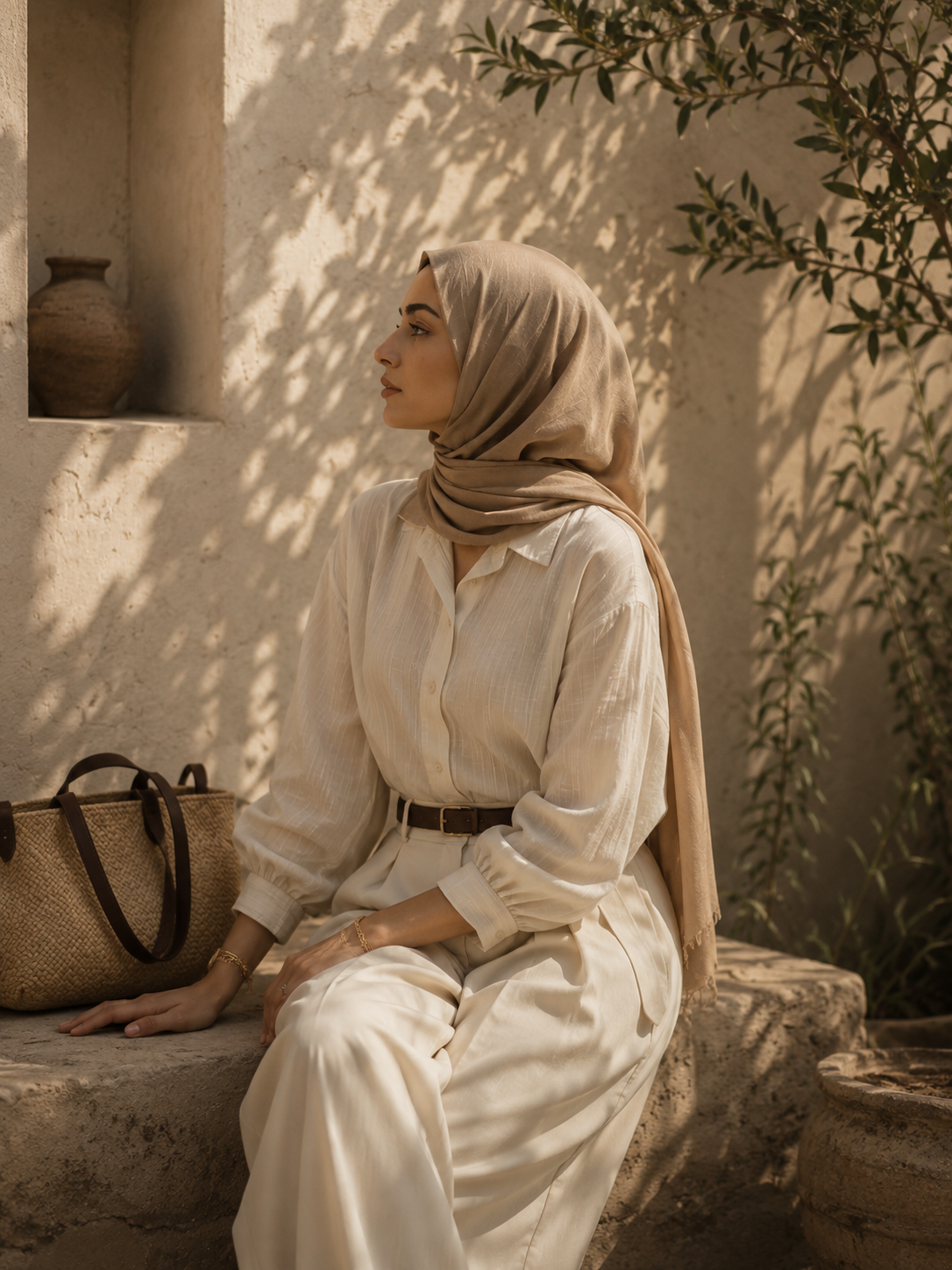
Pay attention to a woman in a well-made abaya and you can read her. The weight of the fabric tells you something. The color tells you something else. The way the sleeve breaks at the wrist, whether the cuff is lined in silk, the choice of a contrast hem, the angle at which the scarf is draped, the brooch she chose for the shoulder, the way the whole composition moves when she walks. There is no shortage of signal here. There is, in fact, more signal than a less-covered wardrobe is even able to carry, because every centimeter of cloth is doing communicative work.
Exposure is a single language. The covered wardrobe speaks several at once.
The covered wardrobe is not a mute wardrobe. It is a polyphonic one. The reason it can be misread as quiet is that the modern eye, trained on a century of skin-as-statement, has lost some of the literacy it would need to hear what fabric is saying.
Why Modest Dressing Is Having a Moment Again
We are living through a quiet correction. After decades of fashion's exposure spiral, a generation of women, including many with no religious or cultural reason to dress modestly, are turning back toward coverage. They are calling it different things: quiet luxury, old money, demure dressing, soft elegance, slow fashion. But the underlying instinct is the same. They are tired of being asked to express themselves only through what they remove. They want to express themselves through what they choose, layer, drape, and keep.
The women who have been dressing modestly all along were never opting out of self-expression. They were practicing a different, older, and considerably richer form of it. The rest of the world is catching up.
The Defense, in Short
This is the argument Mizyana is built around. We do not think of modesty as a constraint on style, and we do not think of self-expression as something that ends where the fabric begins. We think the most expressive thing a woman can put on is the piece that says exactly what she means it to say, on her terms, in her language. Sometimes that piece is loud. Often it is quiet. Always it is hers.
Self-expression is not skin. It never was. The fashion industry simply forgot.