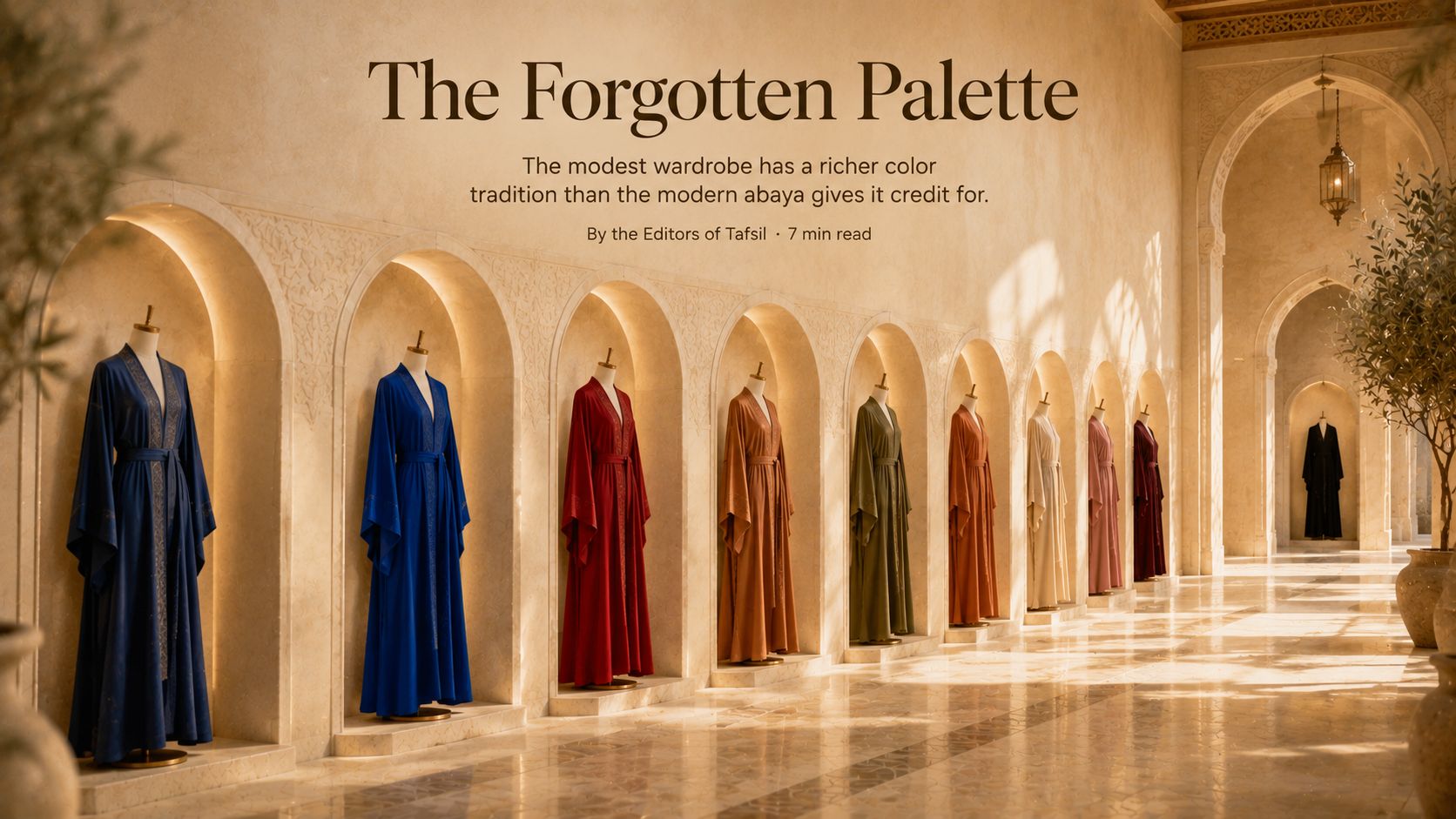



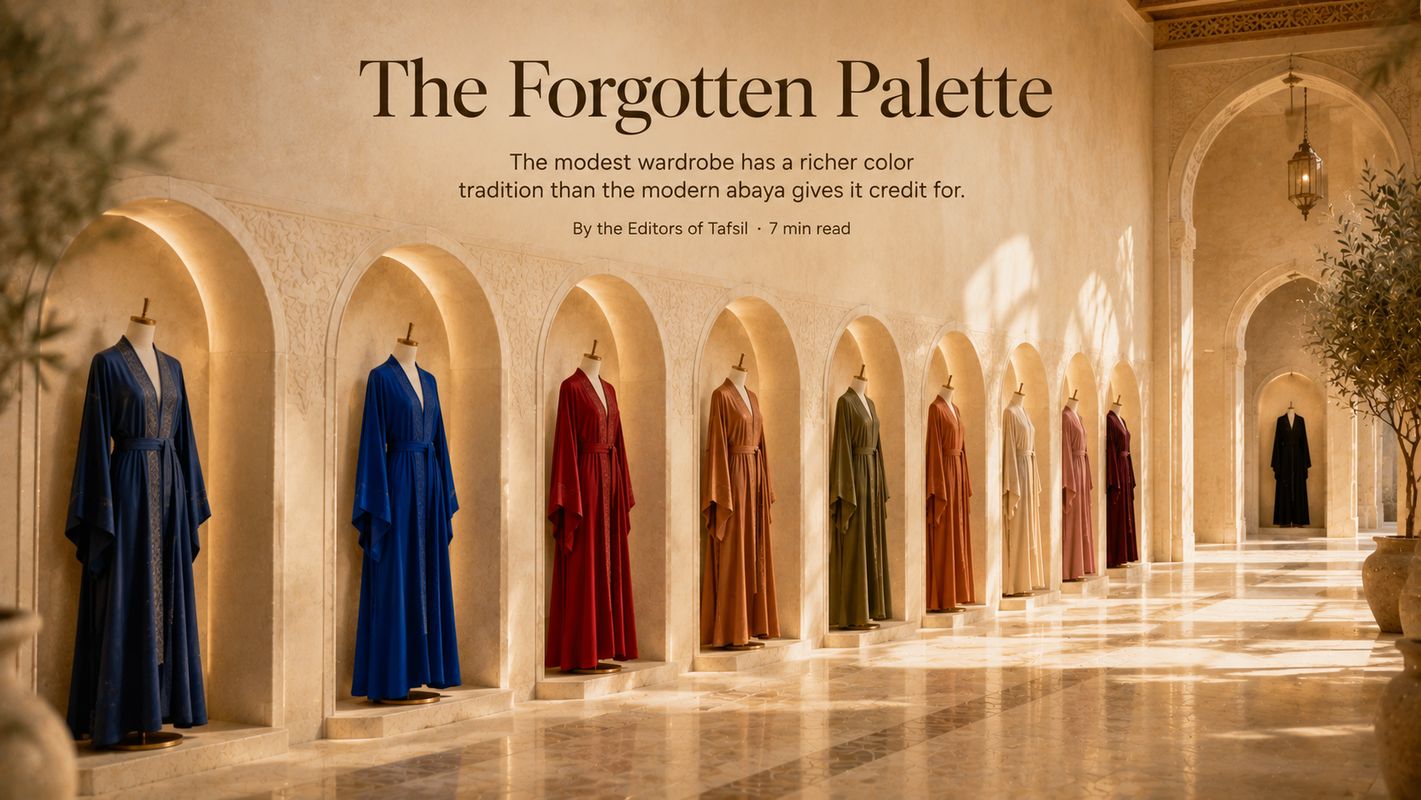
The modest wardrobe has a richer color tradition than the modern abaya gives it credit for. A defense of the full palette.
By the Editors of Tafsil · 7 min read
Picture a modest fashion magazine cover. Picture a website hero image for an abaya retailer. Picture the abaya emoji on your phone keyboard. In each case, the image you produced was, almost certainly, black.
The black abaya has become so visually dominant in modest fashion that we have forgotten it is one option among many. We have built an entire global category around a single shade and called the result "modest." This is a flattening. It is worth saying out loud.
This is not an argument against black. It is an argument against the assumption.
Black Is Not the Problem
Black is one of the most considered colors a wardrobe can carry. It is dignified. It is forgiving across decades. It does not date. It is what serious editors of every fashion tradition, from Saint Laurent to the women of the Gulf, have reached for when they wanted clothes that worked harder than the eye realized. A well-made black abaya is one of the great garments of the twentieth and twenty-first century. We are not going to pretend otherwise.
The problem is not that women wear black. The problem is that the global imagination has come to believe black is what modesty looks like, and the rest of the palette has been quietly erased from the conversation.
The Color Tradition We Have Forgotten
The actual history of modest dressing is in color, and not in any tentative way.
Walk through old Damascus and you would see kaftans the color of deep ruby, embroidered with gold thread that took a month to lay down. The Moroccan djellaba comes in cobalt blue, in mustard, in dusty rose, in every shade the dyes of Fez and Marrakesh could produce. Yemeni women have worn indigo, the color soaked into the cloth so deeply that the dye lived in the skin for days. The traditional thobes of the Saudi interior, before standardization, included deep reds and burgundies that women still recognize when they see old wedding photographs. In Iran, in Pakistan, in Indonesia, in Malaysia, the modest wardrobe has always carried color, often boldly, often layered, often regional in a way that told a woman's whole biography in a single glance.
None of this was less modest because it was not black. The coverage was the same. The intention was the same. Only the imagination was wider.
How Black Came to Dominate
There are reasons. They are worth naming.
Some of them are practical. Black is more forgiving in heat than the chemistry suggests. It hides dust and sun damage in a way lighter shades do not. It looks consistent across photographs and storefronts. A black abaya can be worn from morning to night, from school run to majlis, without anyone asking questions. There is real utility in the choice.
Some of them are commercial. A retailer selling one color has fewer SKUs to manage, fewer dyes to source, fewer choices to confuse a customer. The rise of mass-produced abayas in the late twentieth century pushed the category toward standardization, and standardization tends to mean monochrome.
And some of them are aspirational. The black abaya, in the Gulf, has carried a kind of quiet prestige for decades. It is associated with the women of certain cities, certain families, a certain register of dignity. Color, by contrast, has sometimes been read as more provincial, more traditional in the older sense, more bound to a specific place. The black abaya travels. The Yemeni indigo, in modern fashion conversations, often does not.
These reasons are real. They are not wrong. But they have produced a category that is much narrower than the tradition it claims to represent.
Black is not the absence of choice. But it has often been mistaken for one.
Color as Modesty's Other Tradition
If modesty is a wardrobe philosophy, then the philosophy was never about a particular shade. It was about intention, fabric, cut, drape, the way a woman composes herself for the world. None of those principles require black. A modest wardrobe in deep emerald or burnished bronze or dusty terracotta is no less modest than the same wardrobe in black. The intention is intact. What is gained is the recovery of a tradition the modern industry forgot it had.
We think the future of modest fashion is wider than the current visual default. Not in the trend-cycle sense, where pastels return for spring and burgundy for autumn. In the deeper sense, where a woman building her wardrobe over a lifetime can choose from the whole palette her great-grandmother had access to, and add to it. The Yemeni indigo and the Moroccan cobalt and the Levantine ruby are not historical curiosities. They are wardrobe choices that have always belonged to the modest tradition, and they are still beautiful.
Mizyana curates brands that work in the full palette, not just the comfortable one. We are interested in the abaya that is black because the woman chose black, and just as interested in the abaya that is sand or olive or carmine because the woman chose that. The colors are not the modesty. The choice is.
What we are arguing, in the end, is this. Modest dressing is older, bigger, and more colorful than the global imagination has given it credit for. The black abaya is not the only correct answer. It was never supposed to be.