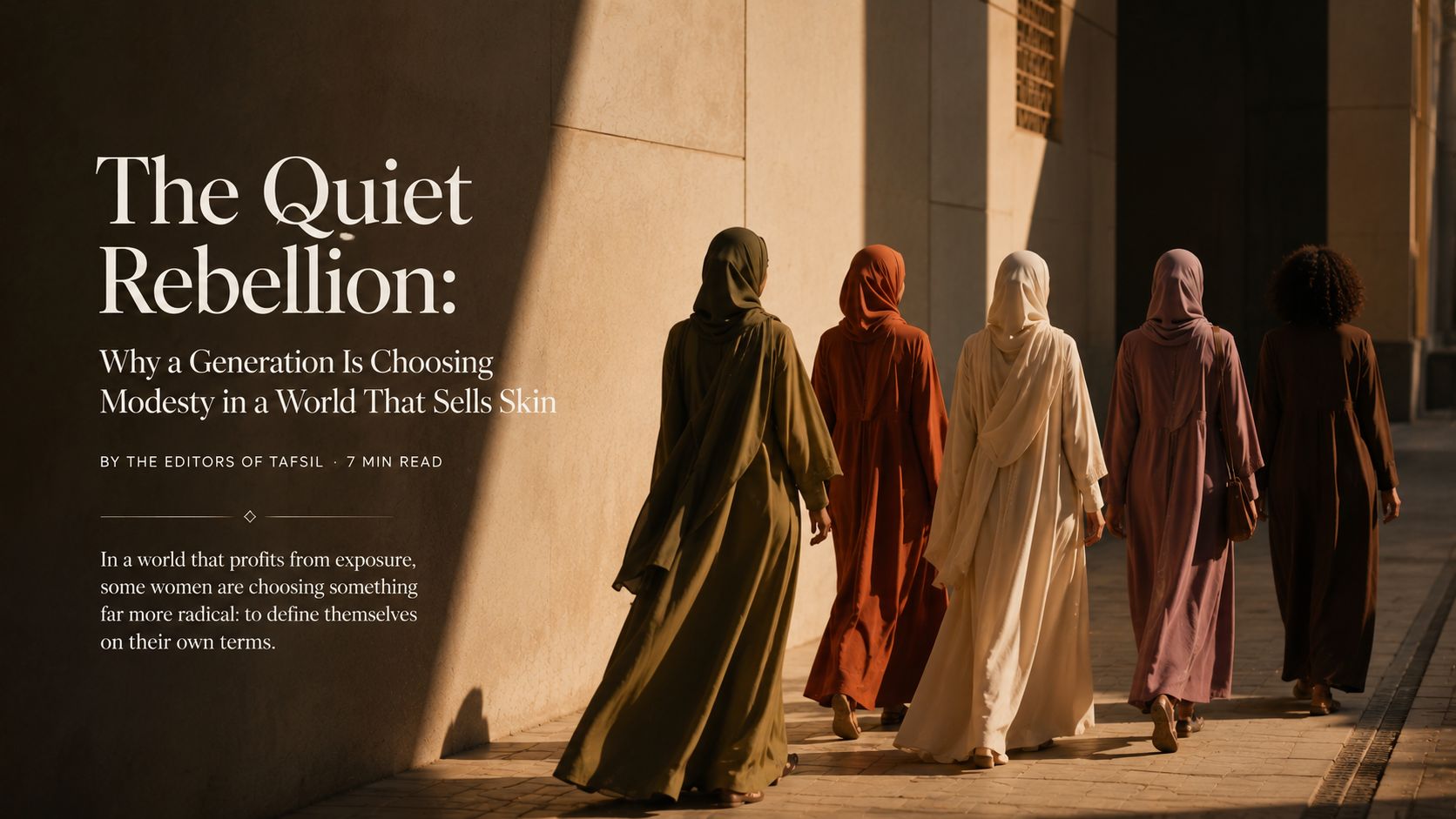



Something is shifting in how women dress. It is not loud. It does not have a manifesto. But it is real, and the fashion industry, which spent decades telling women that less is more, is only beginning to understand what it means.
By the Editors of Tafsil · 7 min read
The numbers are not subtle. Search interest in "modest fashion" has grown every year for the past decade. Quiet luxury, slow dressing, demure aesthetics: these are not fringe conversations. They are happening on the same platforms that once made the micro-miniskirt viral. Designers who built their reputations on exposure are quietly lengthening hems. Influencers with tens of millions of followers are choosing to cover more, not less, and their engagement goes up when they do.
None of this is religious. Or rather, none of it is only religious. Something larger is happening, and it is worth naming plainly: a generation raised inside the most skin-forward fashion culture in human history is choosing to cover up. Not because they have to. Because they want to.
What the Industry Built
To understand the rebellion, you have to understand what it is rebelling against. The fashion industry of the last thirty years made a specific promise to women. The promise was that visibility equals power. That to be seen, fully, without apology, was an act of liberation. Every season brought a new frontier: a lower neckline, a higher hemline, a more considered cut-out. The language around it was always the language of freedom.
The industry was not wrong that there is power in visibility. It was wrong to suggest that visibility is the only kind of power, or that exposure is the only path to it. But for decades, the dominant vocabulary of fashion said exactly that. And a generation of women grew up inside that vocabulary, and some of them eventually looked at it and decided it was too small.
The Exhaustion of Exposure
There is a specific fatigue that sets in when the body becomes the primary argument a woman is allowed to make. When the first question at a fashion moment is how much skin, not how much craft. When a woman walks into a room and the conversation starts at her hem rather than her face.
Women talk about this fatigue in different ways depending on where they are and who they are speaking to. Some call it the male gaze. Some call it objectification. Some do not have a name for it and simply describe the feeling of being evaluated before they have said anything. But across cultures, across age groups, across degrees of religious observance, the experience is surprisingly consistent: there comes a moment when covering becomes not a retreat but a decision. A declaration, actually. One that says: you do not get to start with my body.
Modesty, in this reading, is not a withdrawal from public life. It is a redefinition of the terms on which public life happens.
This is not what the fashion industry expected. It expected that as women gained more freedom, they would choose more exposure. In many cases, they did. But freedom, it turns out, also includes the freedom to cover. And when a woman who has the choice decides to cover, the garment she puts on carries a different weight than it has ever been given credit for.
Why It Is Happening Now
The timing is not accidental. Several forces have converged at once.
Social media made the exposure economy more visible and more exhausting simultaneously. The same platforms that rewarded skin also created the conditions under which women could watch each other, compare, feel surveilled, and eventually look for an exit. The algorithm that pushed maximum exposure also pushed back the reaction against it.
There is also the slow fashion movement, the sustainability conversation, the growing skepticism of fast trend cycles. Women building wardrobes with intention, rather than feeding a seasonal churn, naturally end up somewhere closer to modesty than to maximalism. A piece chosen for fabric, cut, and longevity is almost always a piece that covers well.
And there is, underneath all of this, something harder to measure but impossible to ignore: a revaluation of the private. A sense that not everything needs to be available to everyone. That some things are worth keeping. That the body is one of them. This is not modesty as shame. It is modesty as sovereignty.
What the Modest Fashion World Knew First
None of this is new to the women who have been dressing modestly for generations. Gulf women, South Asian women, Muslim women across the world, Orthodox Jewish women, conservative Christian women across multiple traditions: they have been practicing the thing that a wider generation is now discovering. They were not behind the conversation. They were having a different, quieter one, and the rest of the world is finally in the same room.
What the global fashion industry is now calling a trend, these women have been living as a wardrobe philosophy. The difference matters. A trend arrives, generates content, and leaves. A wardrobe philosophy accumulates. It deepens. It gets passed down. It earns its own vocabulary, its own craft, its own designers and makers who understand what it asks of a garment.
The rebellion is real. But it is joining a tradition that was never absent. It was simply overlooked.
What Mizyana Is For
This is the moment Mizyana was built for. Not because the trend is good for business, but because the women choosing modesty, whether for the first time or for the thousandth, deserve a marketplace that takes that choice seriously. That understands the garment is doing work. That asks the same questions a thoughtful dresser would ask: what is this fabric saying, what does this cut do, where does the eye land, and does this piece hold up across a decade or only across a season.
The quiet rebellion does not need to be sold anything. It needs to be served. That is a different thing entirely. And it is the thing we are here for.